Canaliculi are narrow channels in the bone matrix that form a branching network through the lamellae and between lacunae and function in communication, nutrient exchange, and waste removal. Cytoplasmic extensions of osteocytes, called filipodia, accomodate these channels allowing a method of communication between neighbouring osteocytes, which are linked via gap junctions (Janqueira et al., 2005). The canaliculi also serve as a connection between lacunae and nourishing tissues, such as the marrow cavity, vessels of the Haversian canals, and the periosteum (Martini, 2006).
- Spongy Bone -
Mature spongy bone also has concentric lamellae with lacunae and canaliculi housing osteocytes and their filipodia. However, the lamellae are not arranged into osteons.
Bone spicules form an open network of branching trabeculae, with bone marrow found within the spaces. Unlike compact bone, the bone matrix of the spicules are not vascularized - osteocytes must rely on diffusion of nutrients and wastes from the marrow and endostium lining along the penetrating canaliculi (Martini, 2006).
Fig.5. Spongy or trabecular bone
(from http://w3.ouhsc.edu/histology/Glass%20slides/69_02.jpg)
Osteogenesis
There are two different ways in which osseus tissue is formed: - Intramembranous ossification (i.e. direct bone formation from mesenchymal stem cells)
- Endochondrial ossification (i.e. ossification of a preexisting cartilage template)
[*Note:
ossification = replacing other tissues with bone]
Both processes involved the production of
primary, or woven bone, first; a primitive form of spongy bone. This type if osseous tissue is characterized by:
- large number of cells, a thick
- irregular network of collagen fibers
- irregular arrangement of lacunae (and hence, osteocytes).
Primary bone is the first to form during
fetal development, as well as in
fracture repair. Generally, woven bone is only temporary, and usually converted into mature secondary, or lamellar, bone in adults. However, there are three places where woven bone can be found in adults:
- sutures of flat bones in the skull
- tooth sockets (gomphosis)
- some tendon insertions
Mature secondary, or lamellar bone is more organized and regular (see Fig.3.):
- lacunae are regularly arranged along lamellae
- collagen fibers are concentric and parallel within the lamellae
However, as previously stated, the organization of the lamellae is different in compact and spongy bone.
Mature bone is formed by either intramembranous or endochondrial ossification in different regions of the body (Janqueira et al., 2005).
1) Intramembranous ossification:Occurs in the
skull,
clavical (collar bone), and part of the
mandible (lower jaw) during embryonic development.
- Mesenchymal stem cells proliferate and aggregate in richly vascularized connective tissue (the primary ossification center), where they differentiate into osteoblasts
- Osteoblasts synthesize and secrete osteoid (or prebone) which form spicules that are calcified to form primitive or woven bone
- The spicules thicken & merge to produce a lattice network of spongy, or trabecular bone
- Spaces between the trabeculae contain loose, highly vascularized hematopoietic connective tissue that becomes primary bone marrow.
[*Note: Spongy bone
MAY OR MAY NOT be converted into compact bone. If so, secreted osteoid fills the spaces between the trabeculae and concentric lamellae are deposited around blood vessels to form osteons. Specialized connnective tissue on the outer surface becomes the periosteum.] (Janqueira et al., 2005).
2) Endochondrial Ossification:Occurs in most
long bones,
vertebral column,
ribs &
pelvis during fetal development and continuing up until adolescence.
Endochondrial ossification requires a
pre-existing hyaline cartilage models, that are ossified to become bones. Invading blood vessels are important for carrying the necessary cells to the center of ossification.
Involves
two centers of ossification:
(i) Primary (diaphyseal) center of ossification - Formation of a thin woven bony collar (periosteal collar) around the diaphysis by intramembranous ossification
- The perichondrium (i.e. the dense connective tissue layer surrounding cartilage; analogous to the periosteum) of the template becomes the periosteum
- Invasion of the diaphysis by blood vessels that carry osteoprogenitor cells from periosteum that mature into osteoblasts
- Osteoblasts secrete osteoid, and cartilage matrix begins to calcify
- Chondrocytes (i.e. cartilage cells) hypertrophy & die (because there is no diffusion of nutrients across the bone matrix)
- Osteoclasts form a primary marrow cavity, and incoming blood vessels carry in bone marrow cells
- Compact bone is formed (as described previously).
(ii) Secondary (epiphyseal) center of ossification - Later, blood vessels infiltrate the epiphysis
- Chondrocytes of the epiphysis hypertrophy & die upon ossification
- Osteoblasts start building trabecular bone (Janqueira et al., 2005).
- Only a thin layer of the original hyaline cartilage remains on the surface of the epiphysis, forming the articular cartilage which prevents bone damage at the joints (Martini, 2006).
 Fig.7. Endochondrial bone formation (from http://www.cptc.ctc.edu/library/Bio%20118%20Lecture%20Notes%20Rev%200105_files/image048.jpg)
Bone Growth & RemodelingBone is a very dynamic tissue, continually undergoing reorganization and remodeling throughout an individuals life. The bone itself may appear unchanged, but the tissue is recycled by the regulated interactions of osteoblasts and osteocytes. In fact, approximately one-fifth of the adult skeleton is recycled each year. Bone may also change in size, shape, and general internal architecture. The largest changes in bone structure and size occur during the hormonal surge associated with puberty. Sex hormones (i.e. estrogens and androgens), growth hormone, and thyroxine all contribute to this dramatic change (Martini, 2006). Bone is capable of growing in both length and width- they typically lengthen early in development and widen after.
The
epiphyseal growth plate is a narrow region of cartilage located in the
metaphysis of long bones, which is responsible for the
bone lengthening in young people, which can continue up until the age of 20. The proliferation of chondrocytes within this region leads to an increase in the length of the bone during endochondrial ossification. As they proliferate near the epiphysis, chondrocytes hypertrophy and die as their matrix becomes calcified by the action of osteoblasts near the diaphysis. As this occurs, the epiphyseal plate is being displaced (Janqueira et al., 2005). During puberty, osteoblasts are stimulated by sex hormones, growth hormone, and throxyine to produce bone faster than the cartilage can proliferate, leading to narrowing of the plate and
epiphyseal closure (i.e. the epiphyseal cartilage will eventually disappear). When this occurs, the bones can no longer grow in length (Martini, 2006).
The epiphyseal growth plate contains
4 regions (Janqueira et al., 2005):
1)
Reserve cartilage - region closest to the epiphysis side; furthest from the zone of ossification
- resembles mature hyaline cartilage, without any morphological changes
2)
Zone of chondrocyte proliferation - contains longitudinal columns of mitotically active cells (i.e. undergoing division) which grow in size
- also referred to as hyperplasia
3)
Zone of cartilage maturation & hypertrophy - cells accumulate glycogen, and cytoplasm swells
- cells increase in size and increase the size of the lacunae as well.
4)
Zone of cartilage calcification- cartilaginous matrix becomes calcified by the deposition of hydroxyapatite
- chondrocytes die due the inhibition of nutrient diffusion across the calcified matrix
- forms the border between cartilage and the zone of bone deposition (i.e. ossification)

Fig.7. Cellular regions of the epiphyseal cartilage(from http://www.med.mun.ca/anatomyts/msk/bone5.gif)

Fig.8. X-ray of a joint (arrows point to the epiphyseal growth plate)from http://www.shoppingtrolley.net/images/epiphyseal-plate.gif)
Bones grow in width or diameter by the process of appositional growth.
This process involves the deposition of bone to the outer surface of preexisting bone, leading to continued outward growth in series of layers. Each layer forms a circumferential lamellae surrounding the entire bone.
Osteoprogenitor cells located in the inner cellular layer of the periosteum differentiate into osteoblasts, then secrete osteoid which is calcified to form bone. When the osteoblasts are completely surrounded by matrix, they differentiate in
to osteocytes. At a slightly slower rate, osteoclasts erode bone at the inner surface of the marrow cavity. Therefore, the marrow cavity gradually gets larger as the bone increases in width (Martini, 2006).
As the bone grows outward, some of the older, deeper circumferential lamellae are remodeled, and replaced with osteons. It is also common for older osteons to be replaced by new ones by the deposition of lamellae by osteoblasts. When this occurs, the re
mnants of old osteons are visible in between or underlying the new ones, and are referred to as interstitial lamellae.
PathologyA defect in any of the above mentioned components, and processes, characteristic of bone can lead to a variety of disorders. Here are a few:
1)
Osteopenia:
inadaquate ossification, leading to thinner weaker bones.
This is a normal part of the aging process. With age, osteoblast activity begins to decline, however, osteoclast activity remains the same; therefore, bones are undergoing erosion faster than new bone can be produced. Reduction in ossification begins between the ages of 30 and 40, and occurs more rapidly in women. Osteopenia is most obvious in the epiphysis of long bones, vertebrae, and jaws, leading to the weakening of the limbs, a reduction in height, and loss of teeth, respectively (Martini, 2006).
2)
Osteoporosis: a
reduction in bone mass to a degree that compromises normal function; essentially severe osteopenia.
This leads to fragile bones that can be broken under minor stresses (e.g. standing). Osteoporosis is more common in women, due to the decline in estrogen production, which play a part in stimulating osteoblasts to form bone. Men, on the other hand, continue to produce androgens until later in life. Osteoporosis may also be caused by cancerous cells that release an osteoclast-activating factor, thus accelerating the erosion of bone tissue (Martini, 2006).
3) Osteomalacia: a softening of bone due to a
decrease in its mineral content. An example of this type of condition is rickets (Martini, 2006).
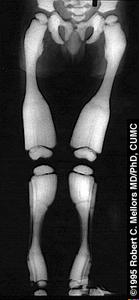
Rickets: a childhood disorder that reduces the amount of calcium salts in the skeleton, allowing bones to bend under the body's weight (e.g. "bow-legged").
Rickets is usually the result of a vitamen D3 deficiency. Thi
s may result from either inadaquate exposure to sun, which activates vitamen D3 in the skin, or from a vitamen-deficient diet. Vitamen D3 a precursor to the hormone calcitriol, which is essential for calcium and phosphate absortion in the digestive tract. If calcium and phosphate are not absorbed, they cannot be used to calcify bone.
Flexibility of bones is due to the flexibility of the collagen fibers; the poor mineralization leads to decreased rigidity, and the bones' ability to withstand compression and tension. The femur bones thus bend laterally under the body's weight (Martini 2006). Rickets also causes the epiphyseal growth plate to become distorted, and bones become deformed (Janqueira et al., 2005).

4) Osteitis fibrosa cystica: a condition in which
increased osteoclast activity results in erosion of bone matrix and degeneration of fibers, due to excess parathyroid hormone secretion (Janqueira et al., 2005).
5) Osteopetrosis: a genetic disease in which
osteoclasts lack a ruffled border; bone resorption is therefore defective.
This results in overgrowth, thickening, and hardening of bones. Other than having extremely dense and heavy bones, this condition diminishes the bone marrow cavity and its hematopoeitic ability. A decrease in blood cells may lead to anemia and increased susceptibility to infection (Janqueira et al., 2005).
6) Pituitary dwarfism: stunted growth caused by
inadaquate production of growth hormone from the anterior lobe of the pituitary gland prior to puberty.
It is not the direct effect of growth hormone that creates this effect, but its subsequent stimulation of somatomedins from the liver. During the years of growth, deficient growth hormone has effects on the epiphyseal cartilage that inhibits
proper bone growth (Janqueira et al., 2005).

Fig.13. A family with pituitary dwarfism (from http://trc.ucdavis.edu/biosci10v/bis10v/week4/4webimages/dwarf.gif)
: immense bone growth resulting from an
overproduction of growth hormone before puberty.
At this time, growth of the bone in length is uninhibited due to the presence of the epiphyseal growth plate (Martini, 2006). As for pituitary dwarfism, the condition is not due to the growth hormone directly, but by somatomedins from the liver (Janqueira et al., 2005).
8) Acromegaly: a skeletal abnormality caused by
overproduction of growth hormone after puberty (Martini, 2006).
Once the epiphyseal growth plate has closed, bone lengthening is inhibited, however, it can still increase in width by appositonal growth (Janqueira et al., 2005). The bones become very thick, leading to obvious deformaties of the face and hands (Martini, 2006).

Fig.15. An individual with acromegaly (from http://www.sd-neurosurgeon.com/images/acromegaly%201.jpg)
: a genetic condition linked to
defective production of fibrillin, a connective tissue glycoprotein.
This deficiency of fibrillin leads to extreme height and long, slender limbs due to excessive epiphyseal cartilage formation, and cardiovascular problems due to the mutated structure of the connective tissues (Martini, 2006).
10)
Scurvy: a condition involving weak, brittle bones as a result of a
vitamen C deficiency in the diet. Vitamen C is an important cofactor for the enzymatic production of collagen, so other tissues, such as the skin, is affected as well (Martini, 2006).
It is also important to note that abnormal levels of particular hormones and vitamens, possibley due to another condition, have an affect on bone structure and function.
References:Junqueira, L.C., and Jose Carnerio. Basic Histology: Text and atlas. 11th ed. USA: McGraw-Hill, 2005.
Martini, Frederic H.. Fundamentals of Anatomy & Physiology. 7th ed. San Francisco: Pearson Education Inc., 2006.
 Figure 1. Cumulative Proportion of Women Assigned to Receive Placebo or Parathyroid Hormone (1-34) (PTH) at a Daily Dose of 20 µg or 40 µg Who Had One or More Nonvertebral Fractures (Panel A) and the Cumulative Proportion Who Had One or More Nonvertebral Fragility Fractures (Panel B) during the Study. (from https://content.nejm.org/cgi/content/full/344/19/1434#F1)